

Thanks to its compact size, much of Formentera, with its many stunning beaches and picturesque villages, can be explored in a day.
Exploring by bike or e-bike is a popular option, where you can visit lovely spots within easy reach of the port of La Savina. Alternatively, you can hire a car or a scooter and venture further afield.
Beyond the beaches and villages, there are many other lovely sights - many of which showcase the island's history - that we encourage you to take the time to visit.
The Lighthouses of La Mola and Cap de Barbaria
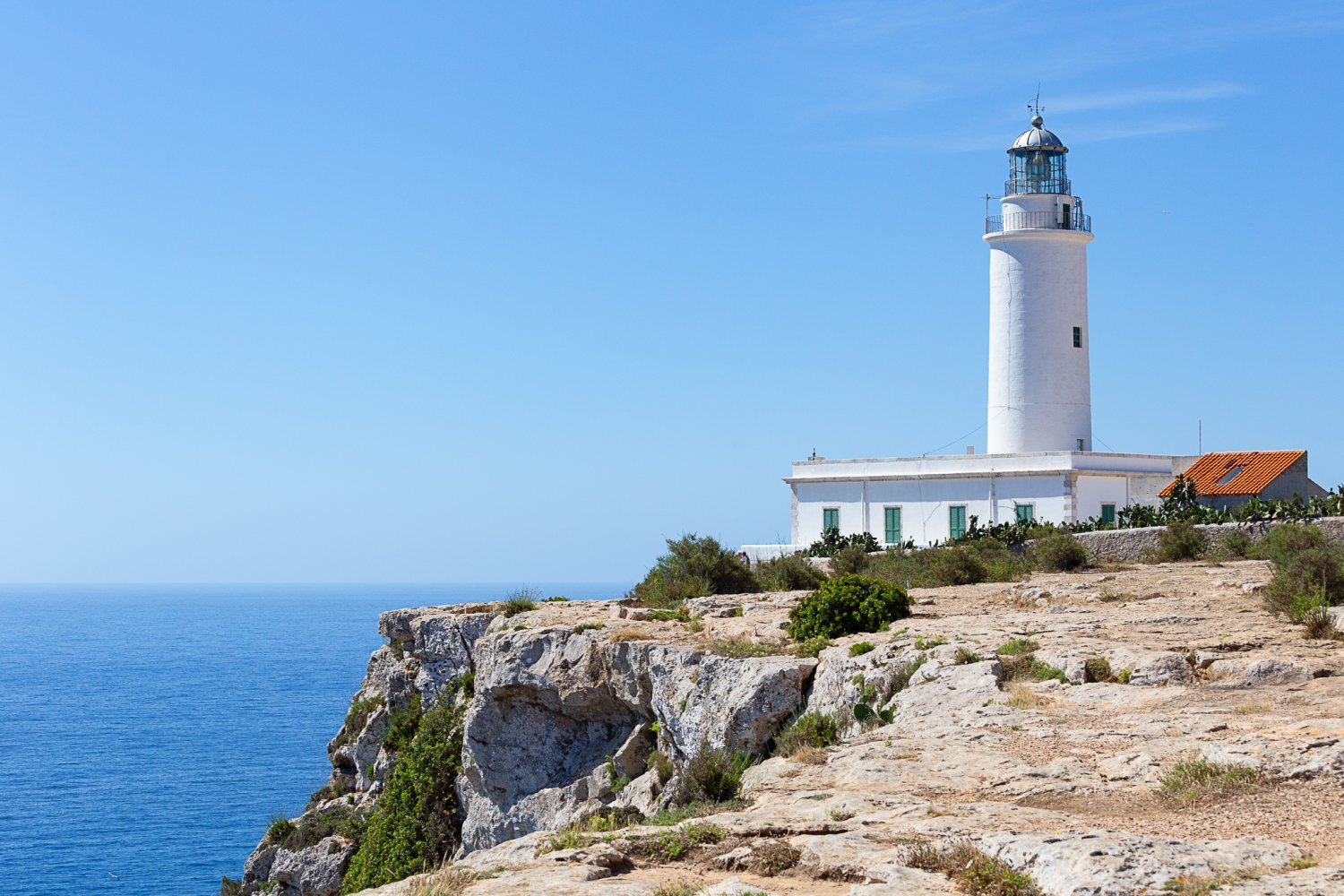
At the eastern tip of Formentera, La Mola Lighthouse stands dramatically on the edge of a 120-metre-high cliff, with sweeping Mediterranean views.
Its former maritime museum is now a cultural space dedicated to the island's artistic and cultural heritage, with a permanent collection of 56 works by artists connected to Formentera. It is open to visitors from Tuesday to Sunday, with additional Wednesday and Sunday afternoon hours. An admission fee is charged.
At the opposite end of the island, Cap de Barbaria Lighthouse occupies an equally spectacular but much more barren setting, perched above 100-metre cliffs. The lighthouse itself is not open to visitors, but the surroundings are well worth the journey, particularly towards sunset.
In the summer season, vehicles are restricted on the final stretch of road, so expect to walk or cycle from the car park. Just 150 metres away, Torre des Garroveret, an 18th-century watchtower, provides another reason to explore the area.
Cova Foradada
Close to the Cap de Barbaria lighthouse, look for a small opening in the rocky ground: this is the entrance to Cova Foradada. The cave leads through the rock to an unusual viewpoint overlooking the sea. Take care when accessing it, particularly on the descent, as this is a natural site rather than a formal attraction.
Formentera Ethnographic Collection in San Francisco
Although a small museum, it still packs in plenty of interesting artefacts and information about how the people of Formentera once lived.
Displays include traditional clothing, agricultural tools, household utensils, and exhibits on historic island trades such as salt production and fishing.
Ca Na Costa megalithic graves near Es Pujols
Between Es Pujols and the inland lake of Estany Pudent in the north of Formentera lies one of the oldest prehistoric burial sites in the Balearic Islands, the megalithic graves of Ca Na Costa.
Here you will find a circular burial chamber made of large stone slabs, surrounded by concentric paving rings, dating back to around 2000 BCE.
Excavations uncovered the remains of eight people, along with pottery, flint, and bone buttons.
The Coastal Watchtowers
Formentera's 18th-century watchtowers were built to keep an eye out for pirates and today make rewarding stops for their coastal settings and views. Torre des Pi des Català, overlooking Migjorn, is the only one whose interior can be visited. Its careful restoration reveals how these defensive structures were built, while the elevated position offers fine views over the southern coast. Visits are subject to prior arrangement.
Torre de sa Gavina, reached on foot from Can Marroig, is the one to choose for a wilder experience. The route follows the rocky coast towards the tower, with the sea and neighbouring islets providing the backdrop.
Up on the northern cliffs, Torre de sa Punta Prima occupies a particularly dramatic position, with broad views along Formentera's northern coastline and towards Ibiza.
Visit a local market
For a little retail therapy with a distinctly Formentera feel, why not visit a local market and pick up some island crafts as a holiday souvenir.
Selling a great collection of island-made ceramics, jewellery, leather, textiles, glass and other crafts, with some even featuring live music, they are a great day out.
Mirador de Formentera
Don't miss the Mirador de Formentera on the climb towards La Mola. From this elevated viewpoint, you can see almost the entire island at once, including both the northern and southern coasts and the road stretching west towards La Savina.
It's particularly worth stopping towards the end of the day, when the changing light adds another dimension to the panorama.
Ses Salines Salt Flat
Formentera's salt flats, between La Savina and Ses Illetes, are a beautiful reminder of the island's pre-tourism past. Salt production was once Formentera's main source of income, with the historic works operating until 1984. Today, the shallow ponds take on pink and violet hues, particularly in summer, and attract a wealth of birdlife.
The area forms part of Ses Salines Natural Park and can be explored on foot or by bicycle.
The salt lakes of Estany des Peix and Estany Pudent
Just outside La Savina is the smaller of Formentera’s inland salt lagoons, Estany des Peix, a sheltered natural harbour where many small boats are moored.
Next to it, and stretching east from La Savina, is the larger lagoon of Estany Pudent, named after the natural sulphurous odours once associated with the area.
In summer, mosquito repellent can be useful here. Both lagoons are well worth a visit, wonderfully scenic, and excellent spots for photography.
La Savina to Ses Illetes Green Route
This easy 3.3-km route makes a particularly good way to combine some of Formentera's natural and cultural highlights. Starting in La Savina, it follows the island's former salt industry past Sa Sequi and the Molí de Sal, then continues through juniper and dune vegetation to Cavall d'en Borràs and the famous Ses Illetes beach.
Allow around 50 minutes on foot or 15 minutes by bike; from Ses Illetes, you can continue along Es Trucadors for views towards S'Espalmador.
Read more...
For more things to do, read also our extensive Formentera island guide.